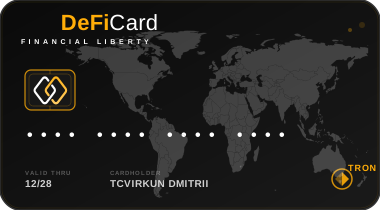
DeFiCard — financial freedom at the intersection of blockchain and card protocols.
Decentralized card payment system: blockchain connected to card protocols
DeFiCard is the next step in the evolution of the crypto industry and financial freedom in its practical sense: blockchain connected to card protocols. We connect two infrastructures that previously lived separately: cryptocurrency in the holder's wallet and ordinary card acceptance at the merchant, supporting all card technologies — ISO 8583, 3DS v2 and EMV. Spending cryptocurrency is now as simple as spending money from a bank card.
Existing card systems (Visa, Mastercard) — banking settlement model.
At the core of existing card systems is the banking settlement model. The path of money from the cardholder to the merchant passes through several banks and the payment system itself. Participants deposit funds in the payment system to speed up settlement — but even with deposits, money still moves through accounts between banks, and final crediting to the merchant is delayed due to bank transfers "account → account".
Step 1 · Cardholder
The cardholder's account is held at the issuing bank. The holder does not keep money themselves — they entrust it to the bank.
Step 2 · Issuer and Payment System
The issuer debits the account and transmits information to the payment system through interbank settlement.
Step 3 · Acquirer and Merchant
The payment system transmits data to the acquirer, which credits the merchant. To make this work faster, participants deposit funds in the payment system in advance. But even with deposits, money moves through accounts between banks, so final crediting is delayed due to bank transfers "account → account".
Why this is a banking settlement model
Cardholder → issuer → payment system → acquirer → merchant. At each step there are banks or settlement organizations, and money moves through accounts, not directly. Deposits smooth out some delays but do not eliminate them completely: settlement still goes through bank transfers "account → account", so crediting to the merchant is delayed.
DeFiCard changes the architecture itself: settlement happens at the moment of transaction, in cryptocurrency, directly between the holder's wallet and the acquirer.
Blockchain connected to card protocols. Settlement — at the moment of transaction.
DeFiCard connects two infrastructures that previously lived separately: blockchain and card protocols. All card technologies are supported, including ISO 8583, 3DS v2 and EMV. DeFiCard has no chain of "issuer → payment system → acquirer" with deposits. Everything happens at the moment of transaction: holder's wallet → DeFiCard → acquirer → merchant. Cryptocurrency immediately ends up with the acquirer or merchant — and they can use it immediately, rather than waiting for settlement day.
Existing card systems (Visa, Mastercard)
- Money is held in accounts at banks
- Settlement goes through issuer and acquirer
- Participants deposit funds for acceleration
- Crediting to merchant — delayed due to "account → account" transfers
- Does not work without banks and SWIFT
DeFiCard
- Cryptocurrency in the holder's wallet — not in a bank account
- Money with the merchant at the moment of transaction
- Working capital is not frozen in payment system deposits
- Own card host and card numbers — not an add-on to Visa
- Works in regions without banking infrastructure
For crypto projects — a card in an hour and income from clients. For acquirers — growth in volume.
DeFiCard solves two problems at once. Any crypto project can issue cards in just an hour and gain additional income from clients plus a new service that boosts loyalty. Acquirers get simplified cryptocurrency acceptance — which, as cases show, directly increases conversion and turnover.
For Crypto Projects
Card in an hour · income · loyaltyA card in an hour via white label API. A crypto project — wallet, DeFi service, DEX, exchange, or exchanger — issues its own cards without banks and BIN sponsors. And immediately gets two things: additional income from clients and a new service that boosts loyalty.
- Additional income from each client transaction
- A new service — a reason to stay in the ecosystem
- Client funds don't leave the service
For Acquirers
Accessibility · conversion · turnoverCryptocurrency acceptance where bank cards don't work. DeFiCard removes friction from the payment process — and this directly translates into growth in conversion and turnover. Market cases confirm this.
- Standard card acceptance — no infrastructure overhaul
- Support for ISO 8583, 3DS v2 and EMV
- Works in regions with bank card declines
- Growth in conversion and transaction volume
Simplified payment boosts conversion — cases confirm it
Growth in completed transaction conversion and +58% transaction volume after simplifying crypto payments.
Of clients switched to crypto payments after simplifying acceptance — solving the card decline problem in entire regions.
Growth in overall conversion after simplifying the process — +75% year-over-year.
The market is ready. 457M users prefer non-custodial wallets.
DeFiCard operates at the intersection of four markets: crypto exchanges, DeFi protocols, exchange services, and card acquiring. 457M is the market potential, i.e., those who prefer non-custodial wallets and DeFi services and, consequently, could be DeFiCard holders. This is not the number of cards issued.
DeFiCard is an independent payment system, not an add-on to existing card systems.
Gnosis Pay and MetaMask Card are card products based on existing card systems (Visa, Mastercard): issuance goes through a BIN sponsor, settlement — through traditional card infrastructure. DeFiCard is an independent decentralized card payment system: its own card numbers, its own card host.
| Parameter | Visa / Mastercard-based cards (incl. Gnosis Pay, MetaMask Card) | DeFiCard |
|---|---|---|
| Category | Product based on existing card systems (Visa, Mastercard) |
Independent decentralized card payment system |
| Money flow | Holder → issuer → payment system → acquirer → merchant |
Holder's wallet → DeFiCard → acquirer → merchant |
| Capital freeze | Participants deposit funds in the payment system to speed up settlement |
No deposits required: settlement happens on the blockchain |
| Role of banks and SWIFT | Critical — the system doesn't work without them |
Not needed: settlement happens on the blockchain |
From an IT service for crypto projects to a financial license in DIFC.
DeFiCard develops in two consecutive stages. The first stage is providing the service as an IT service for crypto projects and crypto acquirers. The second stage is obtaining a financial license in DIFC to provide services to institutional participants: banks, PSP, EMI.
Stage 1 · IT service for crypto projects
- White label API: cards for crypto projects and crypto acquirers in an hour
- Settlement in cryptocurrency at the moment of transaction, no banks and SWIFT
- Clients: crypto exchanges, wallets, DeFi services, exchangers, crypto acquirers
- Own BIN and issuing bank not required
Stage 2 · Financial license in DIFC
- Obtaining a financial license in DIFC to work with regulated models
- Services to institutional participants: banks, PSP, EMI
- Direct fiat settlement with acquirers and merchants
- Access to a broader market and regulated scenarios
What people most often ask about DeFiCard.
Briefly on the essentials — so you can quickly understand if DeFiCard fits your scenario.
What is DeFiCard?
How does the money flow work in existing card systems (Visa, Mastercard)?
How does the money flow work in DeFiCard?
Why will this be in demand?
Do I need a bank to use DeFiCard?
How is DeFiCard developing?
How is DeFiCard different from Gnosis Pay and MetaMask Card?
Who can issue a DeFiCard card?
How does payment with a DeFiCard card work?
Building the card layer for the crypto economy.
Join the DeFiCard ecosystem at the launch stage. We are open to dialogue with crypto exchanges, DeFi services, non-custodial wallets, exchangers, acquirers, as well as institutional participants — banks, PSP, EMI.
- Discuss integration and partnership scenarios
- Provide technical documentation and architecture
- Work through the economic model for your scenario
- Respond within 2 business days